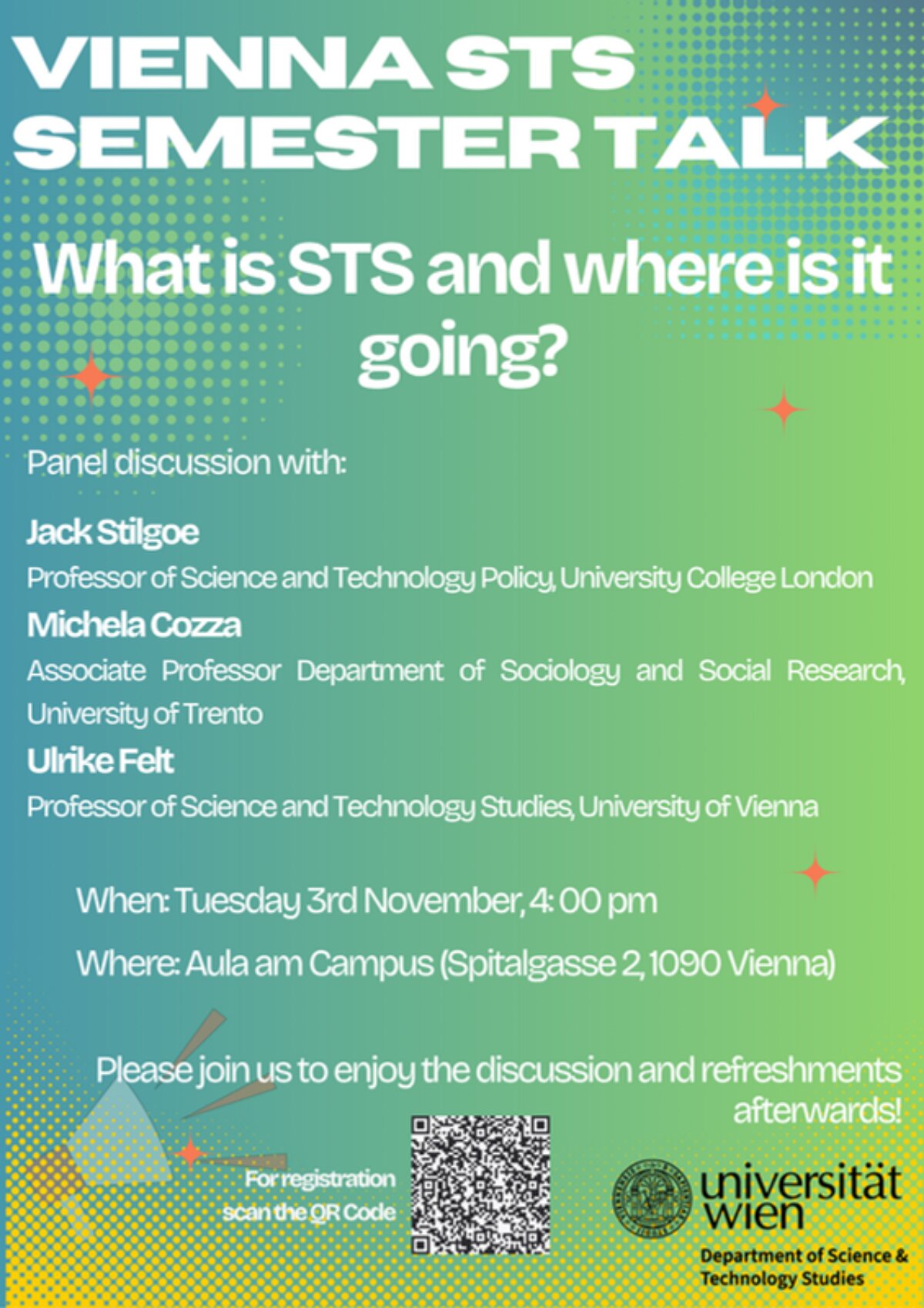
You are warmly invited to the first STS Vienna Semester Talk, taking place from 4pm on Tuesday 3rd November in Aula am Campus, Spitalgasse 2, 1090 Vienna.
Please join for us an informal panel discussion on the topic
‘What is STS and where is it going?’,
chaired by Max Fochler and with guests Jack Stilgoe (UCL, UK), Michela Cozza (University of Trento, Italy), and Ulrike Felt (University of Vienna, Austria).
The panel will be followed by a reception where you can continue the conversation with our guests and with the Vienna STS community.
Please join us for an opportunity to discuss this important topic and to catch up with friends and colleagues!
Our Vienna STS Semester Talk is an eco-friendly event. The Aula on Campus is accessible for individuals with limited mobility and can be reached by public transport. It is in a short walking distance from Line 43 and 44.
For registration, please click here <https://forms.cloud.microsoft/e/gLCcPE5wBr> or scan the QR Code!
[https://g3kfjfhz2xx7qjdy_rei5ympvnvbdtg0zuovn6rdvvu.canva-cdn.email/8a80053…]
Click here <https://canva.link/8nlonkb9oe9ouy7> if the email is not displayed correctly
Best wishes,
Katrin Hackl
Mag. Katrin Hackl
Research Support & Communication
Department of Science and Technology Studies
University of Vienna
Department of Science and Technology Studies
Universitätsstraße 7 /II/ 6th floor (NIG), 1010 Vienna / Austria
T +43-1-4277-49607
katrin.hackl(a)univie.ac.at<mailto:katrin.hackl@univie.ac.at>
Liebe Studierende des MA EST,
ich wollte Sie bzw. Euch darauf hinweisen, dass es Probleme bei der Doppelkodierung aller Lehrveranstaltungen für die Lehre in der Wissenschaftsgeschichte für den MA EST im Wintersemester gab. Das hatte zur Folge, dass unsere Veranstaltungen erst jetzt für die Studierenden sichtbar sind. Es können also noch in praktisch allen Modulen M1-M4 weitere Kurse gebucht werden – unter anderem ein Materialienkolloquium bei Anna Echterhölter. Wir freuen uns sehr, wenn Sie/Ihr die Veranstaltungen besucht und Euch noch anmeldet.
Beste Grüße
Nils Güttler
***
Assoziierter.-Prof. Dr. Nils Güttler
Universität Wien
Institut für Geschichte
Universitätsring 1
1010 Wien
nils.guettler(a)univie.ac.at
T: +43-1-4277-40815
Aktuelle Bücher/current books:
- Verwaltete Umwelt (mit Christian Reiß und Mareike Vennen), intercom Verlag 2025. Open Access: www.cache.ch/verwalteteumwelt
- Umweltwissenschaften zur Einführung, Junius Verlag 2026.
Aktuelles Projekt/current project:
Science for the People: Social Movements and Knowledge Production, 1970s–1900. Information: https://nomisfoundation.ch/projects/social-movements-and-knowledge-producti…
*Call for Abstracts: Workshop From the Origin to the Future of Money *
*31.3.-2.4.2027*
*Institute of Philosophy and Scientific Method (JKU Linz, Austria)*
Political and scientific debates about the future of money are often
underpinned by diverging accounts of money’s origin. This pattern appears
to be relatively stable in the history of monetary theory. Carl Menger put
forward an explanation of the spontaneous emergence of money as a market
phenomenon which is invoked by later members of the Austrian School in
their argumentation against state intervention in the monetary
system. Georg Friedrich Knapp described money as a “creature of the legal
order”; Alfred Mitchell-Innes understood money as credit. Both inspired
post-Keynesians and proponents of MMT to advocate for the active
construction and management of monetary systems. Karl Marx based his
rejection of monetary reform on his view of money as a necessary feature of
capitalism which, if abolished, would spontaneously re-originate.
How to best make sense of the connection between descriptive accounts of
the origin of money and normative proposals for the future of money? Do
investigations into money’s origin allow insights about its “essential
nature” which, in turn, has normative implications? Are positions regarding
the origin, nature, and politics of money as well as the proper method of
investigation embedded in distinct worldviews? Or is the supposed
connection merely a result of naturalist fallacies and strategic attempts
at persuasion?
Addressing these interdisciplinary questions requires joint efforts by
philosophers, economists, and historians. This workshop aims to facilitate
such fruitful interaction and cooperation. Topics for submission include
but are not limited to:
-
Development of different schools of monetary theory and their interaction
-
Comparing and evaluating theories of the origin of money
-
“What is money”: essentialism vs. nominalism
-
Descriptive and normative aspects of monetary theory
-
Discretionary vs. rule-based monetary policy
-
Contemporary proposals for the future of money (cryptocurrencies, CBDC,
MMT, etc.)
-
Methodological individualism and its discontents
-
Methodological problems of different price indices (CPI, OOHPI, …)
-
Worldviews and adversarial collaboration
*Confirmed Speakers:* Jan Greitens (Westfälische Hochschule), Francesco
Guala (University of Milan)
*Abstracts should be 300-400 words (including references, if needed) and be
submitted via e-mail to **jakob.gschwandtner(a)jku.at*
<jakob.gschwandtner(a)jku.at>*, in an editable format (DOCX, ODT, etc.). *All
presentations are in person in Linz.
*Deadline for submissions: 10.12.2026*
Notification of acceptance: 23.12.2026
*Scientific Committee: Alexander Linsbichler (chair) (JKU Linz, University
of Vienna), Jakob *Gschwandtner (JKU Linz), Reinhard Neck (Alpen Adria
Universität Klagenfurt), Julian Reiss (JKU Linz), Stefan W. Schmitz (Vienna
Circle Society, Oesterreichische Nationalbank)
*Organising Committee:* Alexander Linsbichler (chair), Robert Frühstückl,
Jakob Gschwandtner, Pauline Paulik, William Peden, Julian Reiss, Jónatan
Sólon, Evelin Stockinger
The workshop is organised as part of the research project “Carl Menger as a
Central Banker? From the Origin to the Future of Money.”
<https://www.jku.at/en/institute-of-philosophy-and-scientific-method/researc…>,
funded by the Anniversary Fund of the Oesterreichische Nationalbank
(grant-number: 19001). *No conference fee.*
*Alexander Linsbichler*
Institute of Philosophy and Scientific Method (Johannes Kepler University
Linz)
alexander.linsbichler(a)jku.at
Department of Economics and Department of Philosophy (
<https://ufind.univie.ac.at/de/person.html?id=47545>University of Vienna)
<https://ufind.univie.ac.at/de/person.html?id=47545>
alexander.linsbichler(a)univie.ac.at
[image:
https://www.sciencedirect.com/special-issue/325033/adverse-allies-hidden-ha…]
<https://www.sciencedirect.com/special-issue/325033/adverse-allies-hidden-ha…>